Organizations and society under pressure.
I am an organizational consultant and author, specialist in work and organizational psychology, with a background in policing, the Norwegian Police University College and international service with the UN and NATO. I work with organizations on their ability to function and to handle risk, conflict, crisis and change, and on how such conditions play out at the level of society.
A recurring question in the work is how organizations and societies can develop the structures, competence and decision-making processes needed to meet risk.
- Published
- Cappelen Damm Akademisk · Wiley-Blackwell · Routledge
- Experience
- Policing · Norwegian Police University College · United Nations · NATO · Norwegian Government Quarter after 22 July 2011
- Practice
- Independent practice since 2008, with assignments across the Nordic countries. Base in Kristiansand, Norway.
Questions I work on over time.
The work moves between organizational psychology, safety, conflict, preparedness and crisis. The fields overlap, and in practice the problem often lies in the connection between several of them.
Safety and organizational risk
How people, organization and leadership shape risk in everyday work.
The work covers safety culture, workplace violence and threats, organizational risk factors, and how organizations build the capacity to prevent and handle demanding situations.
Safety culture · violence and threats · organizational risk
Preparedness
How organizations prepare for what they cannot fully foresee.
The work covers plans, exercises, situational awareness, coordination, and how experience from incidents is turned into organizational learning.
Preparedness · exercises · organizational learning
Conflict and organizational escalation
How disagreement develops, and which level the problem actually sits at.
The work builds on a level-based model of conflict management developed with the Norwegian Police University College, and covers conflict, whistleblowing, fact-finding investigations and demanding organizational processes.
Conflict · whistleblowing · investigation
Influence and negotiation
How communication and decisions are shaped when interests, power and information are unevenly distributed.
The work covers the psychology of influence and negotiation, and communication in deadlocked and critical situations. Crisis negotiation is a distinct strand here, documented through published work with Wiley-Blackwell and Routledge.
Influence · negotiation · crisis negotiation
Crisis and crisis leadership
How organizations function when conditions change faster than the plan.
The work covers crisis leadership, decisions under pressure, situational awareness, and an organization's ability to function when ordinary ways of working are no longer sufficient.
Crisis leadership · decisions under pressure · situational awareness
It was in the police that I saw how much of the difference lay in the people and the organization around them.
My background spans policing, military and international service, academia and independent advisory work. It includes operations for the United Nations in South Lebanon, work connected to NATO, service as Police Superintendent and Assistant Professor at the Norwegian Police University College, and, since 2008, an independent practice advising public and private organizations. Following the terrorist attack on Norway on 22 July 2011, I was embedded for several years as a trainer and advisor with the government organization in Oslo that was targeted in the primary blast.
This breadth makes it possible to analyse a problem at several levels at once, from individual and group to organization, institution and society. What runs through the work is an interest in the large questions: how we build organizations that function under pressure, how we reduce organizational risk before it develops into serious events, how power, conflict, trust and leadership shape an organization's capacity to decide, and how new technology can be used to strengthen human and organizational capacity.
Most of the advisory work is confidential. What can be shown is what has been published, and the public contributions concern professional questions and general developments, never client matters.
Books and international contributions
The books combine organizational psychology, practical experience and research. A recurring perspective is that critical events can rarely be understood as isolated individual factors; they must be seen in relation to leadership, organization, culture and coordination.
- Cappelen Damm Akademisk
- Handbook of Crisis Management (Håndbok i krisehåndtering), 2013 and 2nd edition 2022. A four-level model for organizations under pressure.
- Cappelen Damm Akademisk
- Handbook series on conflict management for the justice sector, health and social services, and education. A level-based model developed with the Norwegian Police University College. With Anette Falkum.
- Routledge · 2025
- Chapter on crisis negotiation in an international edited volume: resolving deadlocked situations where conventional communication fails.
- Wiley-Blackwell · 2015
- Crisis negotiation in an international edited volume. Used in curricula in international police and specialist communities.
The form follows the problem, not a predefined deliverable.
Each assignment begins with understanding the situation, the organization and the people in it. The work is done together with those who know the organization, and what comes out of it should be something they can stand behind and use without me. The ways of working are described in Norwegian:
- Digital programmes
- The same professional foundation, different roles and situations
- Simulation and training
- Some situations must be experienced before they can be handled well
A trust-based perspective on preparedness.
I am open to international research, advisory and development collaborations within human factors, organizational resilience, crisis preparedness, safety and immersive training. This includes visiting roles, research and innovation projects, executive education, and collaboration between universities, public-sector organizations and industry.
The Norwegian contribution to such collaborations is a trust-based perspective on preparedness: that safety is built from the ground up, with the person closest to the situation, and that organizations must be designed so that this trust holds when it is tested.
Human factors · organizational safety · societal security · crisis management · organizational resilience · safety culture · workplace violence · conflict and whistleblowing · influence and negotiation · decisions under pressure · scenario and exercise design · VR and immersive learning
Describe the situation as it looks now, and I will tell you whether, and how, I can contribute.


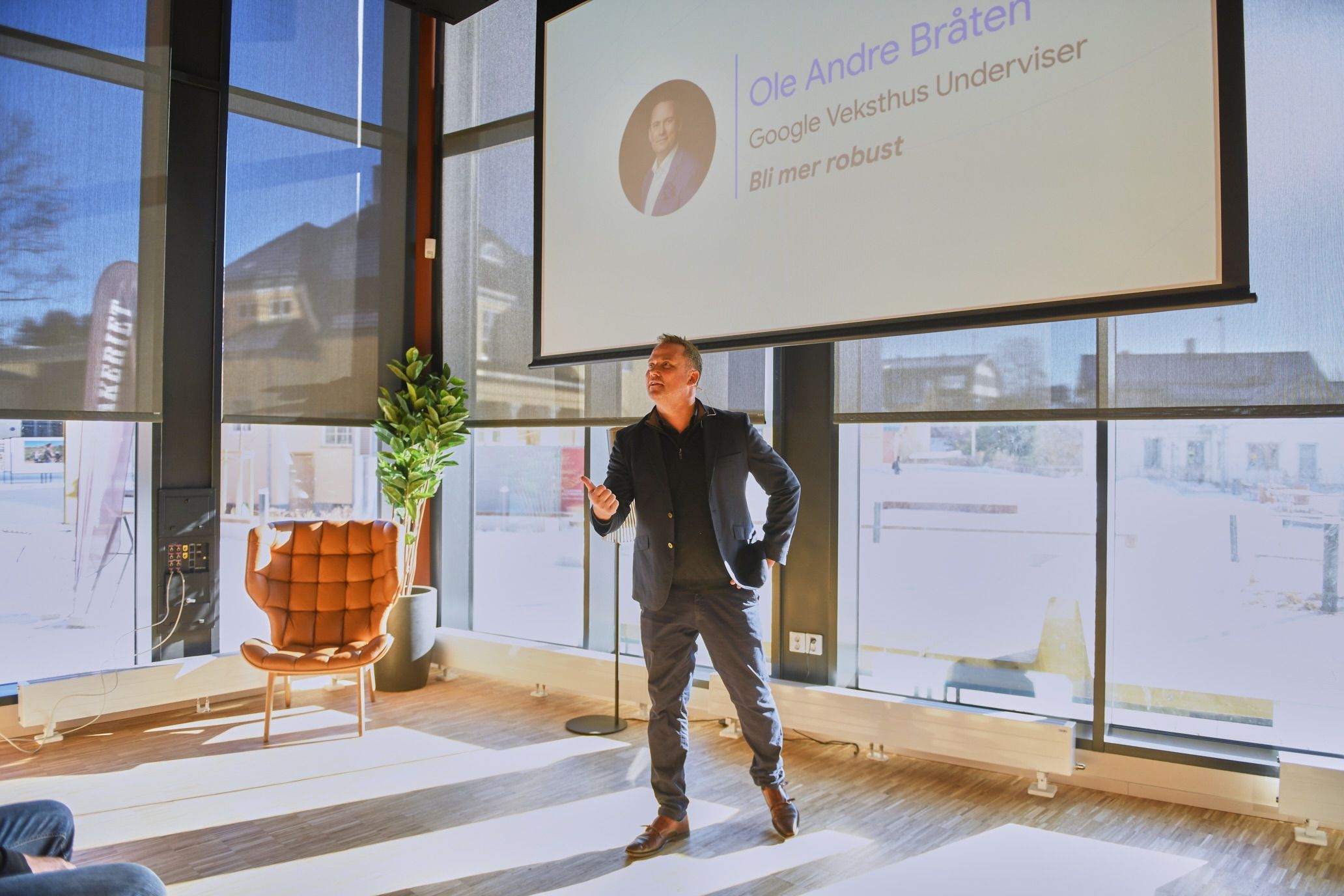
At the launch of a nationwide programme from Google Norway, SMB Norge and Kunnskapsbyen to strengthen the robustness of small and medium-sized businesses - Ole André Bråten, described as one of Scandinavia's leading experts in organisational and leadership development, delivered the opening keynote and led the programme's first workshop, run digitally over Google Meet. One of many digital tools he works with when delivering to organizations wherever they are. Photo: Google Norway.
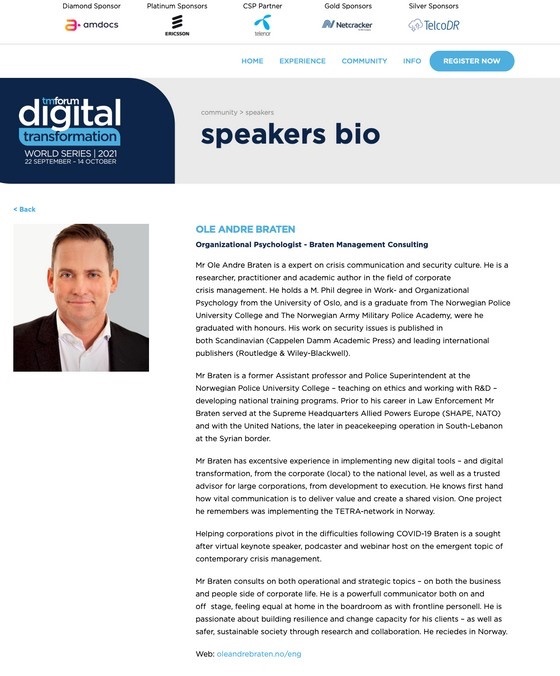
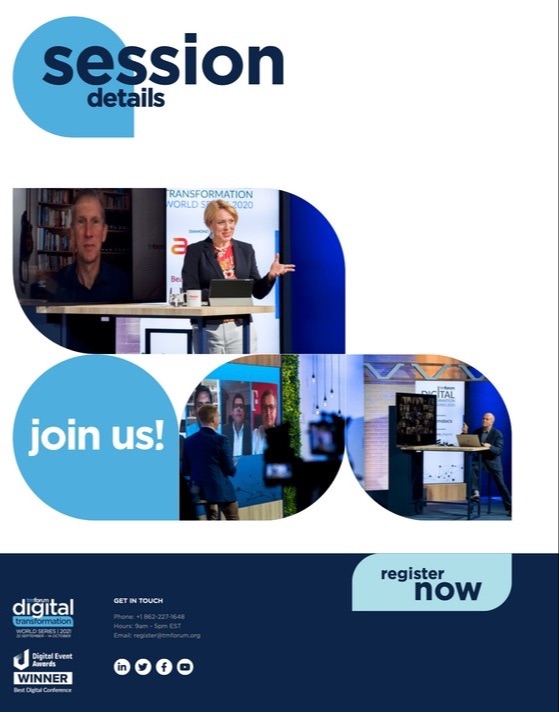
Ole André Bråten was an invited speaker at TM Forum's Digital Transformation World Series, the global conference for the telecommunications industry, sponsored by Amdocs, Ericsson, Telenor and Netcracker. He spoke on crisis communication and security culture in digital transformation, drawing on his experience implementing new digital tools from corporate to national level - including the TETRA emergency network in Norway. The session was delivered virtually, to an audience across time zones. Photo: TM Forum.
Describe the situation as it looks now, and I will tell you whether, and how, I can contribute.
Professional enquiries, assignments, lectures and collaborations. I reply to enquiries myself, usually within one working day. Work can be carried out on site, digitally or as a combination, depending on the situation.
